


Follow us today...




Steven Baker's 234-mile Honda Prologue road trip reads like a masterclass in electric vehicle psychology, where mathematical precision meets automotive anxiety in a high-stakes game of electrons and miles. This isn't just a story about charging an electric car; it's about the mental gymnastics required to navigate a world where your fuel gauge is also your stress meter.
The setup is beautifully simple: a one-way trip that went fine, followed by a return journey that would test every assumption about electric vehicle ownership. Baker knew the return would be "trickier" due to charging infrastructure gaps, with the nearest fast charger sitting 177 miles from home. That's the kind of distance that makes internal combustion drivers shrug and EV drivers start doing calculus.
What follows is a fascinating study in range management psychology. Baker starts at an EVgo station, watching his Honda Prologue crawl from 51% to 98% over 54 minutes while paying a painful 58 cents per kWh. The charging curve tells the whole story: 55 kW average, which is respectable but not spectacular. More importantly, the "guessometer" shows 280 miles of range for a 234-mile trip, with an initial prediction of arriving at a negative 14% charge.
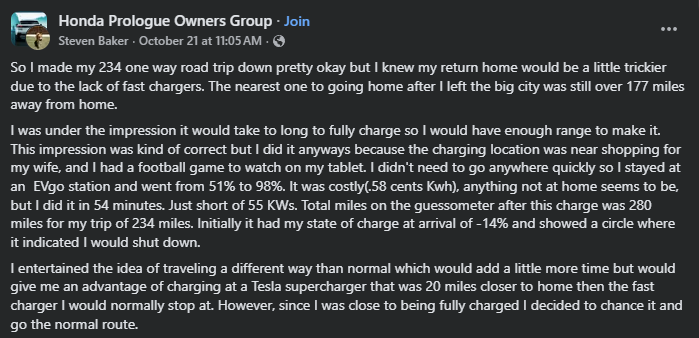
“So I made my 234 one-way road trip down pretty okay, but I knew my return home would be a little trickier due to the lack of fast chargers. The nearest one to going home after I left the big city was still over 177 miles away from home.
I was under the impression it would take too long to fully charge, so I would have enough range to make it. This impression was kind of correct, but I did it anyway because the charging location was near shopping for my wife, and I had a football game to watch on my tablet. I didn't need to go anywhere quickly, so I stayed at an EVgo station and went from 51% to 98%. It was costly(.58 cents kWh), anything not at home seems to be, but I did it in 54 minutes. Just short of 55 kW. Total miles on the guessometer after this charge were 280 miles for my trip of 234 miles. Initially, it had my state of charge at arrival of -14% and showed a circle where it indicated I would shut down.
I entertained the idea of traveling a different way than normal, which would add a little more time but would give me the advantage of charging at a Tesla supercharger that was 20 miles closer to home than the fast charger I would normally stop at. However, since I was close to being fully charged, I decided to chance it and go the normal route.
I traveled the normal route and kept to 70 MPH (speed limit being 75). I had the AC on and the radio. The outside temperature was in the 90s. I made it 50 miles to the last fast charging station closest to home, and the guessometer continued to report I was going to break down short of home. The state of charge at arrival had changed from -13% to -7% but my buffer did shorten from close to 50 miles at the start to just short of 30 miles. My state of charge at the time was 72%.
I stopped at the Ford fast charger (ridiculously .75 cents KWH should have gone for the Tesla Fast Charger the other way at .44 cents KWH. I reached 80% in about 7 minutes, and since I was still watching a little of the late game on my tablet, I decided to charge to 90%. I thought it would take a while as charging is supposed to slow down as you go over 80% (it did when I charged to 98% earlier), but it didn't slow down much. It took me 17 minutes to get up to 90%. I had 250 miles to go, 177 miles. The guessometer said I would have 6% state of charge on arrival.
At about 68 miles, I still had a buffer of 60+ miles, and the state of charge upon my arrival increased to 15% so I readjusted the cruise to 78MPH, increased the AC, and even began charging my phone and tablet. Upon my arrival home, I still had 47 miles and was at 18% state of charge.
The whole thing I'm trying to relate to others, especially people who read our posts that are on the fence and haven't taken the plunge yet, is that you can do it. Range anxiety is real, but there are a lot of options out there to make it safely. Think outside the box. A lot of things I thought would be obstacles weren't really obstacles. Just have to plan and use all your resources.
Home charging is a game-changer. If you primarily have to charge commercially, I probably wouldn't do it because it seems it costs the same as gas, but you don't get the range with a gas vehicle.
Everyone needs to remember that charging is getting better. A lot of access is opening up. There are plans to increase the availability of chargers soon, and we will have a lot more options. (Walmart/Costco/Ionna)
If you're reading this and you work for an automaker or government, you need to help make commercial charging worth the cost of buying an electric over an ICE vehicle.”
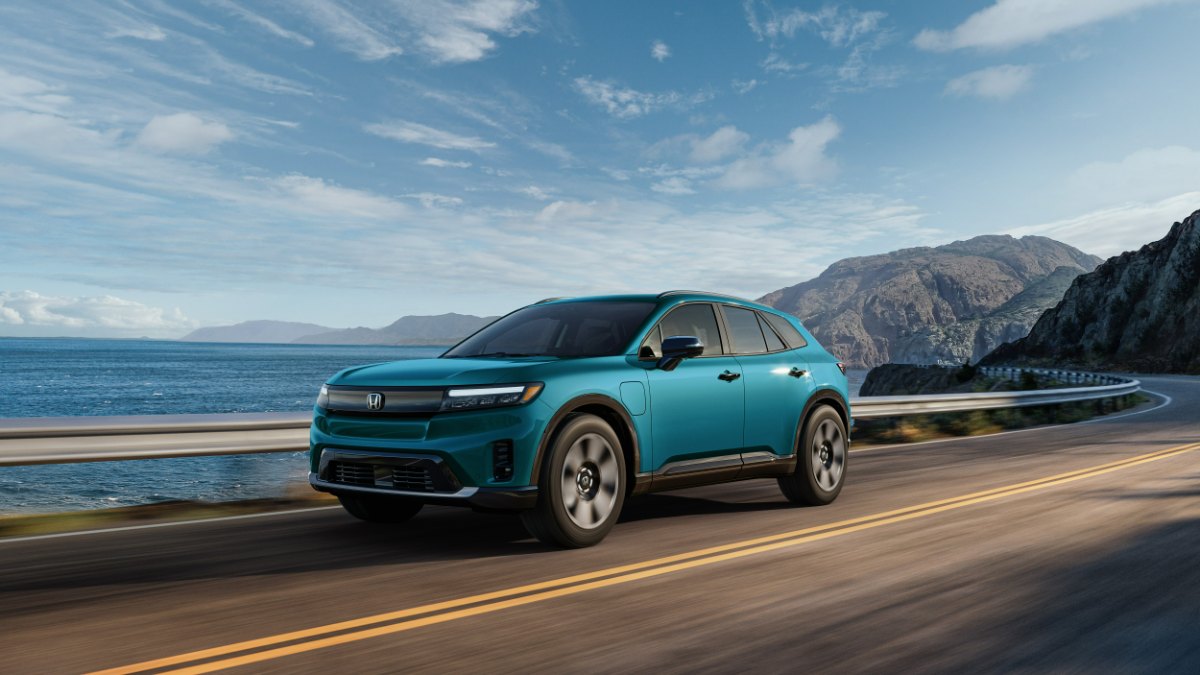
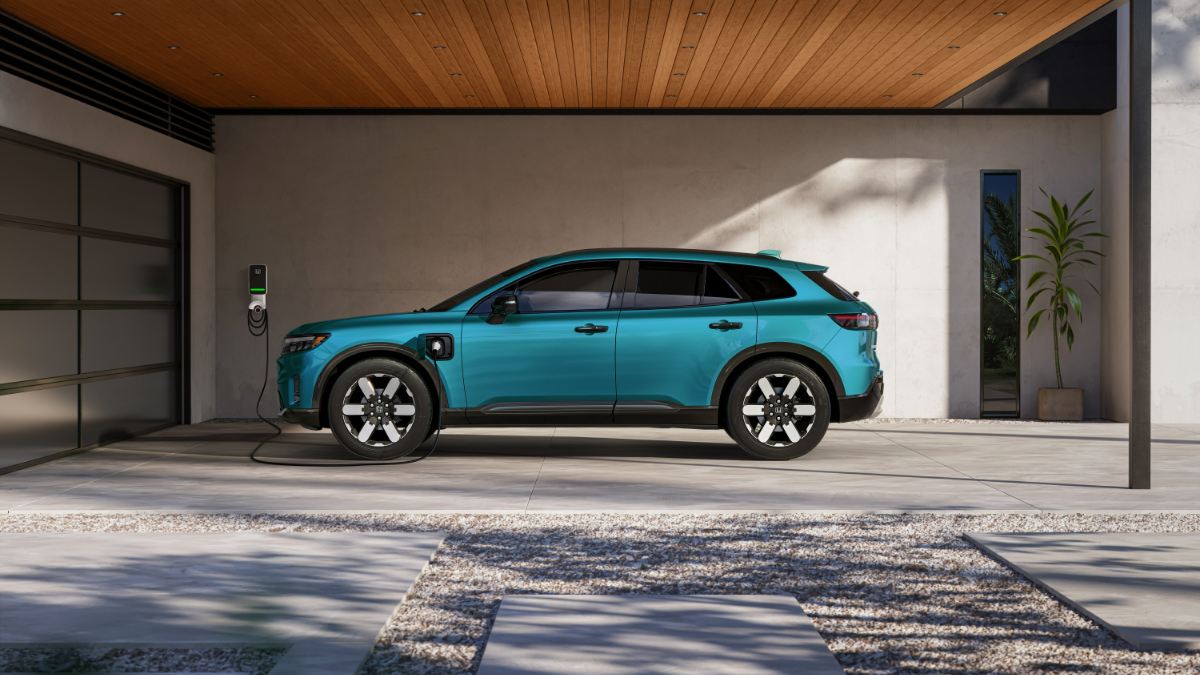
The Honda Prologue's charging capabilities represent the new generation of mainstream electric vehicles, but Baker's experience shows how charging infrastructure still dictates travel patterns. His journey becomes a series of calculated risks, each charging stop a strategic decision that could make or break the entire trip.
Fifty miles into the journey, the guessometer continues its pessimistic predictions, showing arrival at negative 7% despite Baker maintaining a conservative 70 mph in a 75 mph zone. The buffer has shrunk from 50 miles to 30 miles, and he's still at 72% charge. This is where range anxiety transforms from abstract concern to concrete mathematics, where every mile becomes a negotiation between speed, comfort, and survival.
The Ford fast charger stop reveals another layer of EV ownership complexity: pricing chaos. At 75 cents per kWh, it's nearly double what Tesla charges at 44 cents per kWh. Baker's choice to use the expensive Ford charger instead of backtracking to the cheaper Tesla option illustrates how convenience often trumps economics in real-world EV use. Seven minutes to reach 80%, then 17 minutes to hit 90%, with charging speeds that defied expectations by not slowing down significantly.
Facts About The Honda Prologue
- The Prologue is Honda’s first all-electric SUV, built on a GM-based Ultium platform to combine efficiency, performance, and reliability.
- It comes in both single-motor front-wheel-drive and dual-motor all-wheel-drive configurations, offering between roughly 220 and 300 horsepower.
- Powered by an 85 kWh battery, the Prologue delivers an estimated range of about 296–308 miles for FWD versions, with slightly less for AWD.
- Inside, it features Google built-in software, large digital displays, wireless Apple CarPlay/Android Auto, and Honda Sensing safety systems for a modern experience.
- Honda designed the Prologue as a practical, family-friendly EV that brings advanced electric technology to the mainstream market at a competitive price.
What makes Baker's story compelling is his adaptation strategy. At 68 miles from home, with a 60-mile buffer showing on the display, he makes the crucial decision to increase speed to 78 mph, crank up the AC, and start charging devices. This is the moment when range anxiety transforms into range confidence, when the mathematics finally align with reality.
The final numbers tell the real story: arriving home with 47 miles of buffer and 18% charge, significantly better than the guessometer's pessimistic predictions. Baker's experience validates what many EV owners learn through trial and error: the range estimates are deliberately conservative, building in safety margins that often prove unnecessary.
Baker's broader message about EV adoption is spot-on: "Range anxiety is real, but there are a lot of options out there to make it safe." This isn't about dismissing legitimate concerns; it's about recognizing that the infrastructure and technology have evolved to support longer trips, even if they require more planning than traditional road trips.
The electric vehicle charging experience varies dramatically between networks and locations, as Baker's pricing disparities demonstrate. His observation about home charging being a "game changer" cuts to the heart of EV ownership economics: if you can't charge at home, the financial benefits largely disappear.
The infrastructure reality check is equally important. Baker notes that charging is "getting better" with Walmart, Costco, and Ionna expanding access, but his experience shows we're still in the early stages of building a truly seamless charging network. The price variations between networks create a two-tier system where Tesla owners enjoy both better coverage and lower costs.
Baker's call for automakers and government to "make commercial charging worth the cost" highlights the fundamental challenge facing EV adoption. When charging costs approach gasoline prices without offering gasoline's convenience or range, the value proposition becomes questionable for anyone without home charging access.
The future of electric vehicle infrastructure depends on solving the pricing and accessibility problems Baker encountered. His successful 234-mile gamble proves that long-distance EV travel is possible, but it shouldn't require a degree in logistics and a tolerance for financial uncertainty.
What emerges from Baker's narrative is a portrait of EV ownership in transition. The technology works, the infrastructure exists, but the experience remains more complex and expensive than it needs to be. His willingness to share both the challenges and successes provides a realistic framework for potential EV buyers weighing the transition from internal combustion.
The Honda Prologue's performance in Baker's real-world test demonstrates that mainstream electric vehicles can handle longer trips, but they require a different mindset and planning approach. The guessometer's pessimism, while stressful, ultimately provides a safety buffer that prevents genuine range emergencies.
Baker's story is ultimately about adaptation and learning. His successful navigation of charging networks, pricing variations, and range calculations represents the kind of practical knowledge that EV owners develop through experience. The 234-mile gamble paid off, but it required skills and planning that internal combustion drivers never need to develop.
How has your experience with long-distance EV travel compared to Baker's journey? What changes would make electric vehicle road trips more accessible to mainstream drivers? Share your thoughts in the comments below.
Image Sources: Honda Media Center
Noah Washington is an automotive journalist based in Atlanta, Georgia. He enjoys covering the latest news in the automotive industry and conducting reviews on the latest cars. He has been in the automotive industry since 15 years old and has been featured in prominent automotive news sites. You can reach him on X and LinkedIn for tips and to follow his automotive coverage.
Follow us today...


